
Any bleeding, spotting or pink-brown discharge that appears after your periods have stopped completely for at least 12 months is called postmenopausal bleeding. Most of the time the cause is harmless, but it is also the most common first sign of cancer of the lining of the womb (endometrium). That is why even a single drop should be checked by a doctor.
For many years, the first step was a transvaginal ultrasound to measure the thickness of the womb lining; if it was thin, most women did not need a biopsy. Guidelines published in 2026 changed this approach. This article explains in plain language what has changed, why, and what to expect at your appointment.
Why is postmenopausal bleeding important?
Most postmenopausal bleeding is caused by benign conditions. The most common causes are:
- Atrophy: Thinning of the vaginal and womb lining due to low oestrogen, which bleeds easily
- Polyps: Mostly benign growths inside the womb or on the cervix
- Fibroids: Benign growths of the womb muscle (see What Are Fibroids?)
- Hormone therapy: Irregular bleeding in women using menopausal hormone therapy
- Endometrial hyperplasia: Excessive thickening of the womb lining; some types can be precancerous
Studies show that roughly 3 to 10 percent of women with postmenopausal bleeding are found to have womb cancer. Although this sounds low, most womb cancers are detected at an early stage thanks to this symptom, and early-stage womb cancer usually responds well to treatment. So bleeding should never be dismissed as "just age".
The old approach: "No biopsy if the lining is 4 mm or less"
Earlier guidelines considered the risk of cancer very low if the womb lining was clearly visible on transvaginal ultrasound and measured 4 millimetres or less. In these women, follow-up without biopsy was recommended unless the bleeding recurred.
The strength of this approach was that it spared many women an unnecessary procedure. Over time, however, some limitations became clear:
- In women with fibroids, a higher body weight or a tilted womb, the lining may not be fully visible on ultrasound.
- Some less common but more aggressive types of womb cancer (such as serous type) can develop without markedly thickening the lining.
- New studies showed that a thin measurement offers less reassurance than expected in certain groups of patients.
What changed in 2026?
Two important updates stood out in 2026:
1. ACOG's revised recommendation: The American College of Obstetricians and Gynecologists (ACOG) now recommends combining transvaginal ultrasound with endometrial sampling (biopsy) for most women at the initial evaluation of postmenopausal bleeding. In other words, a thin measurement alone no longer means "no biopsy needed" for many women.
2. Joint guideline by AAGL, ESGE and GCH: International societies in gynaecological endoscopy reported that when tissue from the womb is needed, a visually directed biopsy taken during hysteroscopy gives more accurate results than blind sampling, and recommended it as the preferred method.
These changes are also being debated within the profession. Some experts stress that the previous approach is still appropriate for carefully selected women and that biopsy for everyone may increase the number of unnecessary procedures. The final decision is therefore made together with each woman, based on her own risk profile and examination findings.
What happens at the appointment?
When you see a doctor for postmenopausal bleeding, the evaluation usually includes:
- History: Amount and duration of bleeding, hormone use, blood thinners, family history
- Gynaecological examination: To find out whether the bleeding comes from the womb, the cervix or the vagina
- Transvaginal ultrasound: Thickness of the womb lining, polyps or fibroids, condition of the ovaries
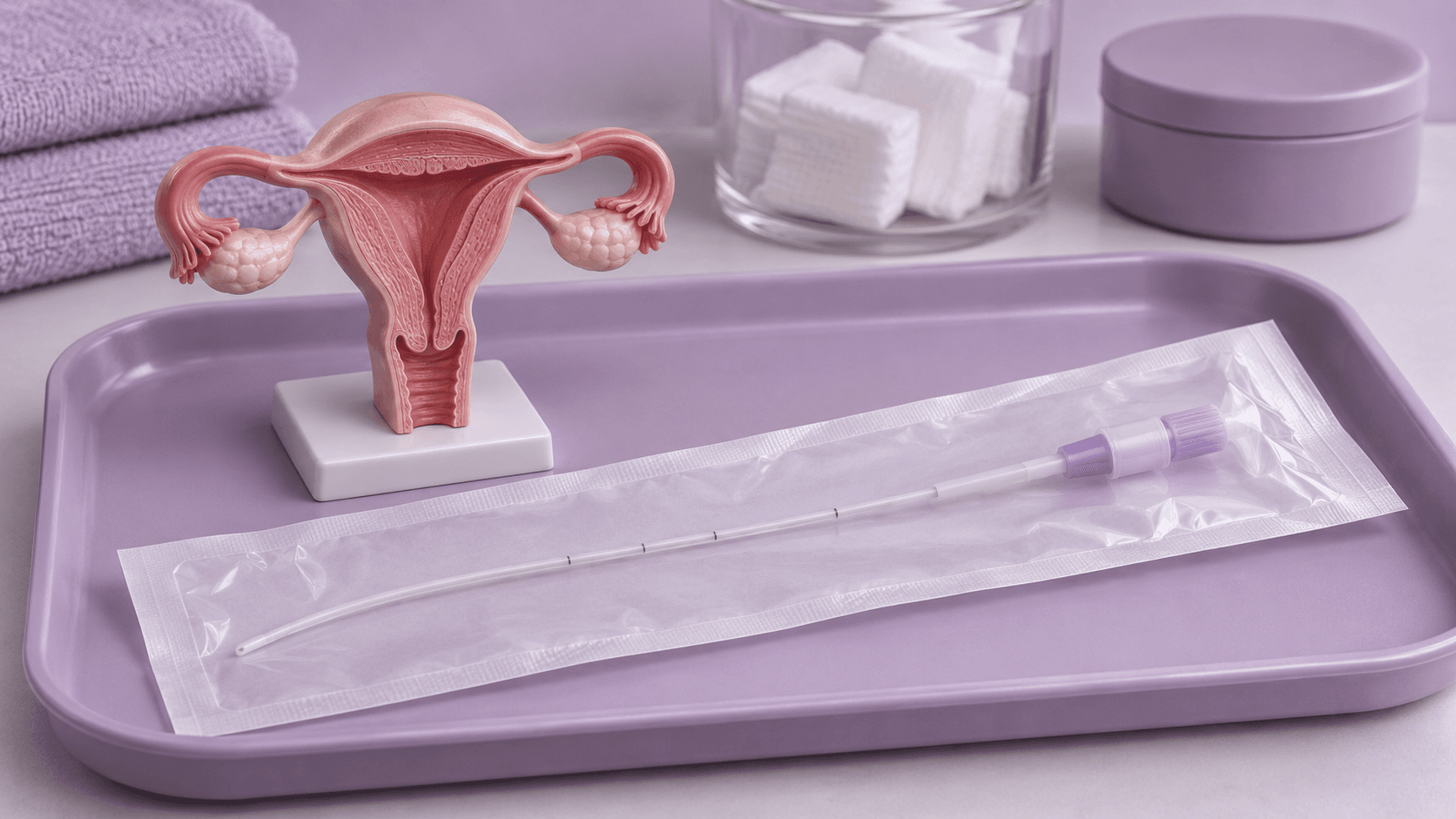
- Tissue sample: Depending on the patient, office sampling with a thin tube (pipelle) or biopsy during hysteroscopy
- Additional tests if needed: Cervical screening (smear/HPV test), rarely MRI
Office biopsy vs. hysteroscopic biopsy
| Feature | Office (blind) biopsy | Hysteroscopic biopsy |
|---|---|---|
| How is it done? | A sample is taken from inside the womb with a thin tube | A thin camera is used to look inside the womb and sample the suspicious area |
| Advantage | Quick, usually done in the clinic | Sees and targets focal lesions such as polyps |
| Limitation | May sample only part of the lining; tissue may be insufficient | Sometimes requires anaesthesia or an operating room |
For more information about hysteroscopy, see Hysteroscopic Surgery.
Is a biopsy painful, and what are the risks?
Most women feel a short cramp similar to period pain during an office biopsy. Because the cervix can narrow after menopause, the procedure is sometimes difficult or may not yield enough tissue; in that case hysteroscopy may be recommended.
Possible risks are rare but should be known: short-term bleeding, infection and, very rarely, perforation of the womb wall. Your doctor will explain suitable pain relief options beforehand.
What happens after the result?
- Atrophy: Usually improves with vaginal moisturisers or local treatments recommended by your doctor.
- Polyp: Removal by hysteroscopy and pathological examination is recommended.
- Hyperplasia without atypia: Usually managed with hormonal treatment and close follow-up.
- Atypical hyperplasia or cancer: Further tests and a treatment plan are arranged. For detailed information, see Womb Cancer Diagnosis and Treatment.
Even if the biopsy is normal, recurrent bleeding requires reassessment.
When should you see a doctor right away?
If you have any bleeding after menopause, however little, book a planned appointment. Go to the emergency department without delay if you have:
- Heavy bleeding that soaks a pad or tampon in less than an hour
- Dizziness, feeling faint, palpitations
- Severe abdominal pain with fever
Conclusion
Postmenopausal bleeding is usually caused by something benign, but as of 2026, saying "the lining is thin, everything is fine" based on ultrasound alone is no longer considered enough for every woman. Current guidelines recommend tissue sampling for many women and, when needed, performing it under direct vision during hysteroscopy. The right path for you is decided by assessing your examination and risks together. If you notice bleeding, the best step is to see a gynaecologist without delay or embarrassment.
Author: Assoc. Prof. Dr. Erkan Elçi, Obstetrician and Gynaecologist. Last updated: November 2026.
Frequently Asked Questions
I had spotting once after menopause. Should I still see a doctor?+
My womb lining was thin on ultrasound. Do I still need a biopsy?+
Is an endometrial biopsy very painful?+
What is the difference between a hysteroscopic biopsy and a regular biopsy?+
Is bleeding normal while on hormone therapy?+

This article is for general information only and does not replace an examination, diagnosis or treatment. Please consult a physician about your symptoms.