
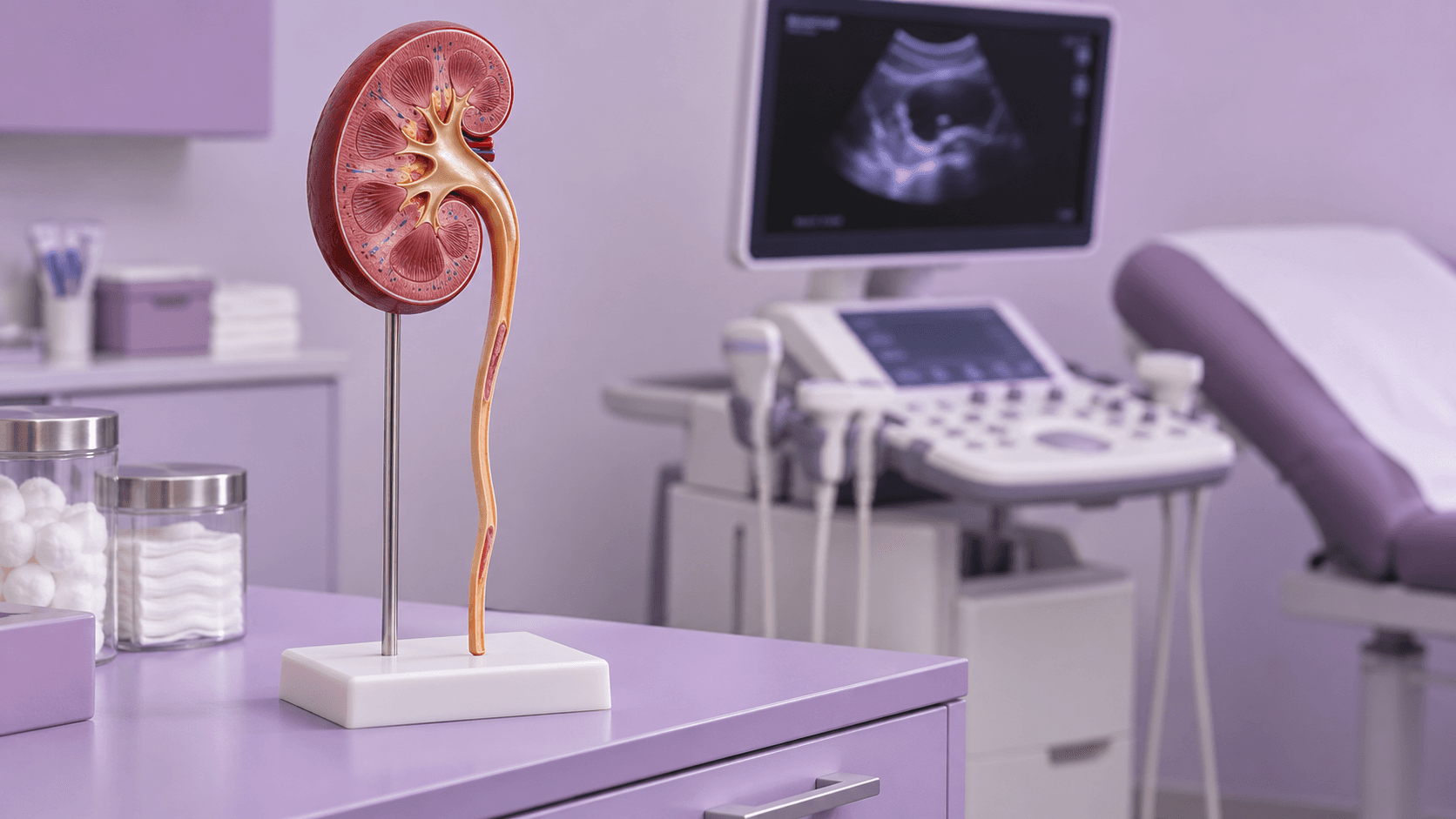
When most women think of endometriosis, they think of severe period pain, endometrioma ("chocolate cysts") and difficulty getting pregnant. In some women, however, the disease can extend beyond the womb and ovaries to the urinary tract. The most important of these is involvement of the thin tube that carries urine from the kidney to the bladder, the ureter.
Ureteral endometriosis is rare, but it matters because it often progresses without causing obvious symptoms. If it goes unnoticed, it can lead to permanent loss of kidney function. This article explains why this condition is "silent", who should be more alert, and the options for diagnosis and treatment.
How does endometriosis affect the urinary tract?
Endometriosis is the growth of tissue similar to the womb lining outside the womb. Over time, this tissue causes inflammation and scarring (fibrosis) around it. For general information about the disease, see Endometriosis Symptoms and Treatment.
Urinary tract endometriosis occurs in a small proportion of women with endometriosis and most often affects the bladder, followed by the ureter. Ureteral involvement is usually associated with deep endometriosis located behind and beside the womb. It can take two forms:
- External compression: Endometriosis tissue surrounds the ureter and squeezes it from outside. This is the most common form.
- Internal involvement: Tissue grows into the wall of the ureter; this is rarer.
In both cases the ureter narrows and urine backs up into the kidney. This is called hydronephrosis (swelling of the kidney due to urine build-up).
Why does it progress "silently"?
When urine flow from the kidney decreases slowly, the body adapts. As a result:
- Many women have no obvious kidney pain.
- When only one kidney is affected, the other takes over, so kidney values in blood tests can remain normal for a long time.
- Symptoms can be mistaken for other endometriosis complaints (period pain, pelvic pain).
The medical literature describes endometriosis cases in which one kidney lost its function over years without being noticed. For this reason, specialists consider it important to image the kidneys in every woman suspected of having deep endometriosis.
Which symptoms should raise concern?
Ureteral involvement may cause no symptoms, but the following should always be evaluated:
- Flank or side pain, especially worsening during periods
- Blood in the urine during periods
- Frequent urination, burning or pain when passing urine
- Recurrent urinary tract infections
- Deep pain during intercourse or pain on opening the bowels (may indicate deep endometriosis)
When to seek emergency care: Severe flank pain with fever, inability to pass urine or a marked decrease in urine output, side pain with nausea and vomiting. In these cases, go to the emergency department without delay.
How is it diagnosed?
Ureteral endometriosis is often discovered during a detailed assessment for deep endometriosis.
- Expert gynaecological ultrasound: Shows the location and size of deep endometriosis lesions.
- Kidney ultrasound: A simple, painless, radiation-free test that shows hydronephrosis. It is recommended as part of the assessment in women suspected of deep endometriosis.
- MRI: Shows the extent of the disease and its relation to the ureter in detail for surgical planning.
- Renal scintigraphy (kidney scan): If hydronephrosis is found, it measures how well each kidney works separately. It is an important guide for treatment decisions.
- Blood and urine tests: To check kidney function and infection.
What are the treatment options?
Treatment is planned individually based on the degree of narrowing, how much the kidney is affected, symptoms and the wish for pregnancy.
Medical treatment
Hormonal treatments can suppress endometriosis tissue and reduce pain. Cases have been reported in which hydronephrosis regressed with medical treatment in mild narrowing. However, in scarred (fibrotic) narrowing, medication alone is usually not enough and close monitoring is essential.
Temporary relief: Stent or nephrostomy
To protect kidney function, a thin tube may be placed inside the ureter (double J stent) or a drain from the kidney through the skin (nephrostomy). These do not treat the underlying disease; they aim to protect the kidney until surgery.
Surgical treatment
The lasting solution is often surgery, usually performed by keyhole (laparoscopic or robotic) methods:
- Ureterolysis: Careful freeing of the ureter from the surrounding endometriosis tissue. Often sufficient for external compression.
- Ureteral resection and reconnection: If the ureter wall is involved, the narrowed segment is removed and the ureter is joined end to end or reimplanted into the bladder.
- Kidney removal (nephrectomy): Rarely needed if the kidney has completely lost its function and causes problems.
These operations require a gynaecological team experienced in advanced endometriosis surgery working together with urologists. Possible risks include urine leakage from the ureter, re-narrowing, urinary infection and stent-related discomfort. For information on keyhole methods, see Advanced Laparoscopic Surgery and Robotic Surgery.
What happens after surgery?
If the ureter was repaired, the stent usually stays in place for a few weeks and is removed at a follow-up visit. Kidney ultrasound is then used for monitoring. Because endometriosis can recur, hormonal treatment recommended by your doctor and regular check-ups are important. For tips on daily life with the condition, read Coping with Endometriosis.
When should you see a doctor?
- If you have endometriosis and have had flank pain or blood in the urine during periods
- If you have been diagnosed with deep endometriosis but have never had a kidney ultrasound
- If a stent was placed in the past and your regular check-ups have lapsed
- If you have emergency symptoms such as fever, severe side pain or inability to pass urine (go to the emergency department)
Conclusion
Ureteral endometriosis is rare, but its ability to permanently damage the kidney without symptoms makes it one of the aspects of endometriosis that should not be overlooked. The good news is that a simple kidney ultrasound can often reveal the problem early, and when caught early, kidney function can largely be preserved. If you have endometriosis, do not hesitate to ask your doctor whether your kidneys have also been checked.
Author: Assoc. Prof. Dr. Erkan Elçi, Obstetrician and Gynaecologist. Last updated: November 2026.
Frequently Asked Questions
Can endometriosis really damage the kidneys?+
I have no kidney pain. Could I still be at risk?+
Can hydronephrosis resolve with medication?+
Can ureteral surgery be done by keyhole surgery?+
I have endometriosis. Should I have a kidney ultrasound?+

This article is for general information only and does not replace an examination, diagnosis or treatment. Please consult a physician about your symptoms.